The Schrödinger equation is to quantum mechanics what Newton's laws are to the classical world: the governing rule from which everything else follows. Erwin Schrödinger wrote it down in the winter of 1925–26, and it made a strange trade. It gave up predicting where a particle is, and in exchange got to predict — exactly, deterministically — how a stranger object evolves: the wavefunction.
In classical physics a particle has a location. In quantum physics it has Ψ — a complex-valued function that carries all the knowable information about the system. Ψ itself is not observable. What is observable, Max Born realized, is its squared magnitude:

The equation that governs Ψ, for a single particle of mass m in one dimension, is this:

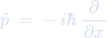
What each symbol owns
The interactive above assigns each term a color and a piece of the scene, so that changing one symbol changes exactly one visible thing. The mapping:
When the potential holds still: eigenstates
If V does not change with time, the wavefunction separates into a spatial shape and a purely rotating phase:

which reduces the problem to the time-independent Schrödinger equation:

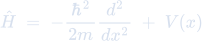
with the Hamiltonian — the total-energy operator, kinetic plus potential:
The classic four
Physicists learn what the equation is capable of by solving it in four idealized environments:
| System | Potential V(x) | What it teaches |
|---|---|---|
| Free particle | V = 0 everywhere | A plane wave — the corkscrew in the interactive, with the barrier off. Energy is continuous, not quantized. |
| Particle in a box | V = 0 inside, ∞ at the walls | Ψ is pinned to zero at the walls, so only standing waves fit — the first clean picture of discrete energy levels. |
| Harmonic oscillator | V = ½kx² | Vibrating molecules. Evenly spaced levels — and a ground state that is not zero: E₀ = ½ℏω. A quantum system cannot fully sit still. |
| Hydrogen atom | V = −e²/4πε₀r | Solved in three dimensions it yields the s, p, d, f orbitals and the shell structure of the periodic table — chemistry, derived. |
The mathematical fine print
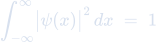
Two conditions keep the whole structure honest. First, wavefunctions live in the Hilbert space L² — they must be square-integrable, so the total probability of finding the particle somewhere is exactly one:
Second, the Hamiltonian must be Hermitian (self-adjoint). That single requirement guarantees its eigenvalues — the energies an experiment can measure — are real numbers, even though Ψ itself is irreducibly complex. The imaginary unit does the evolving; the Hermitian operator makes sure what you measure comes out real.
That division of labor is the equation in one sentence: i turns the phase, the Hamiltonian sets how fast, the potential shapes the landscape, and |Ψ|² is the only part the world lets you see.