Find the passage between passages.
A bridge uses the prose on both sides of a gap, the desired transition, voice, and point of view to propose connecting text. The intended workflow lets the author inspect, edit, accept, or discard it.
A world behind every word.
A reader beyond the page.

A writing studio, a shared story-world catalogue, and a home for authors and readers. Write and Be Found brings the act of writing into conversation with the characters, places, objects, and events that make a story believable—and with the people who will discover it.
A scene may read beautifully and still put a character in the wrong city, return an object to its former owner, or reveal a secret too early. Writing well involves keeping track of much more than words.
Story Forge is the creative workspace at the center of Write and Be Found. Its direction is to connect the manuscript to an inspectable world: AI works with chosen context, catalogue entries inform the prose, and timelines and connectivity diagrams make consequences visible.
The compelling idea is the combination: a calm place to write, a structured memory for the story, and a public home where the work can find readers.
The writing canvas uses warm paper, generous space, and readable typography. Write mode clears the tools from view; chosen tools return when needed. The design keeps the manuscript’s line breaks, caret, and reading position steady while context opens around it.
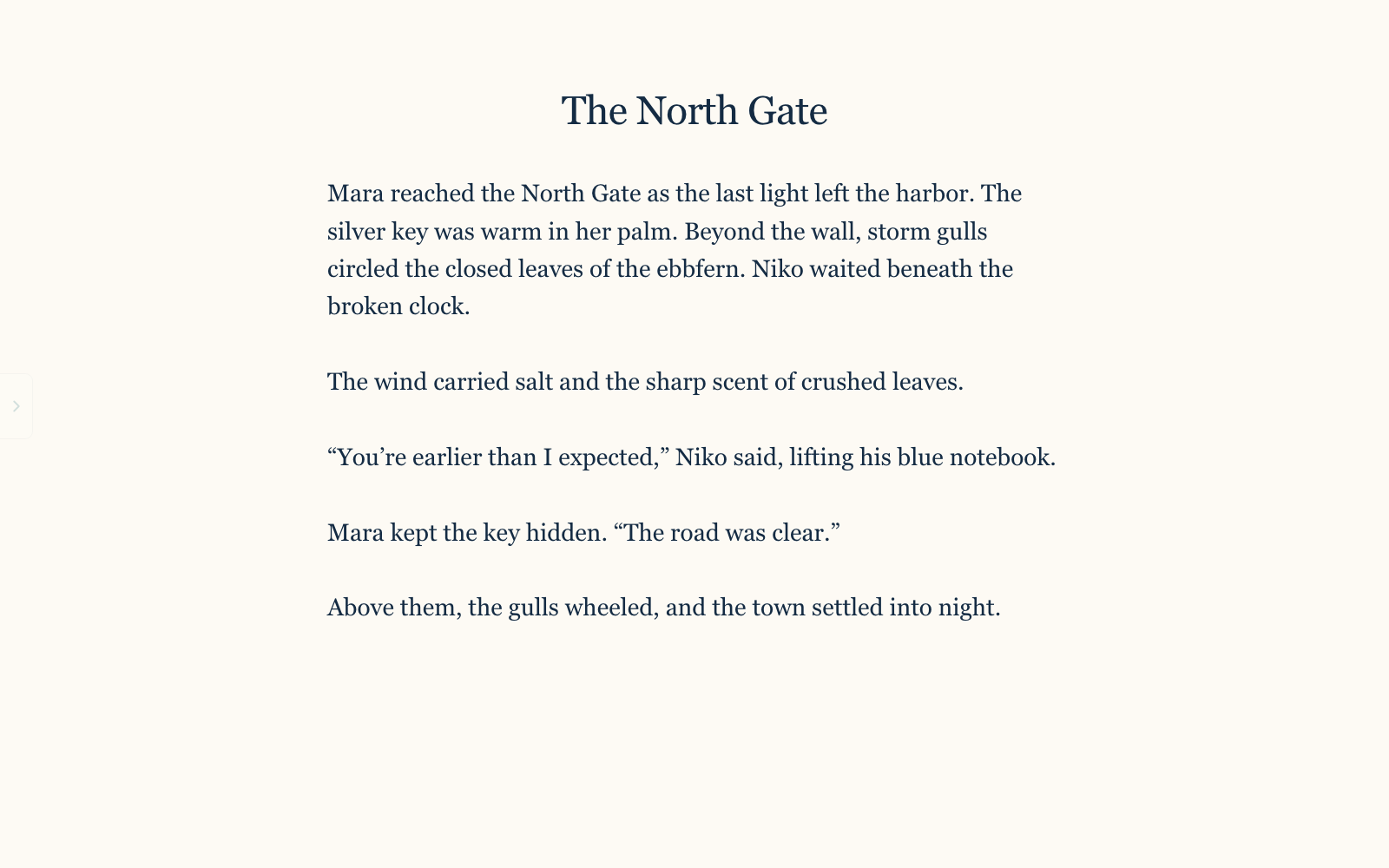
A bridge uses the prose on both sides of a gap, the desired transition, voice, and point of view to propose connecting text. The intended workflow lets the author inspect, edit, accept, or discard it.
The AI feature catalogue includes motivations, goals, fears, flaws, backstory, personality, and appearance. The connected workspace develops this further: suggestions should fit what a character knows, wants, and can plausibly do at that story moment.
The global catalogue is conceived as a shared collection of reusable creations. An author can develop a private story world, deliberately share a creation, or adopt a permitted version into another project while retaining its source and credit.
The planned catalogue insertion workflow brings an entry into the selected passage with AI proofing: check its fit, propose the prose, and show any accompanying changes to the world. Adding a person to a scene can require an arrival, a motive, and an explanation of what they know.
A reusable creation needs clear attribution, permissions, and a known version. The design preserves the receiving author’s local interpretation and makes later source updates reviewable. Sharing an entry does not make a private manuscript public.
Existing catalogue models and editing forms provide a foundation. Global publishing, adoption, and contextual insertion are planned connected workflows in the inspected delivery record.
A key changes hands at the North Gate. Follow the prose, its catalogue context, the timing, and the connections to see why these tools belong together.
Illustrative scenario · fixed examples · no live AI or manuscript changes
Mara left the harbor with the silver key hidden in her coat.
Through the night she followed the wall north. By the time the gate emerged from the mist, Niko’s lantern was the only light still burning.
At dawn, she placed the key in Niko’s hand.
A small silver key with a chipped bow. It opens the North Gate’s archive, but cannot open the outer gate.
“Niko turned the silver key in the archive lock. Beyond the outer gate, the road remained closed.”
Example insertion after checking the object’s recorded purpose.
This Sovereign illustration explains the intended connected workflow. It is separate from the application and does not demonstrate deployed AI, automatic continuity detection, or global catalogue access.
The platform serves both sides of the book. Authors need a place to present their work; readers need a way to find it, learn about its creator, and share their response.
Build a public presence around your identity and books, with theme choices, imagery, a biography, book presentations, a blog, and events. An author’s website gives readers a continuing destination beyond a single release.
Public profiles and book listings are deliberately separate from private manuscript work. The author chooses what becomes visible.
Create an author accountBrowse authors and books, search by title or author, and explore genres. Reader scoring and written reviews are part of the product’s community side: a place for readers’ judgments alongside the author’s presentation.
The repository contains reader review and rating records and submission routes. The complete scoring experience, including average ratings and their display, remains unfinished in the inspected implementation.
Explore book discoveryA writer keeps authority over the manuscript while drawing on AI suggestions, shared creations, and readers’ responses. The global catalogue extends that exchange to the ingredients of stories themselves, with attribution and local interpretation preserved.
Writing tools, worldbuilding, AI assistance, and book discovery are established ideas. Sovereign’s assessment is that the opportunity lies in how closely they work together: fewer breaks between developing a character, using that character in prose, checking the consequences, and presenting the finished work.
Its value will be demonstrated by that whole journey: the author remains in control, the story stays coherent, and the work reaches people who want to read it.
The public site, existing application, and newer Story Forge work are at different stages. This review separates those stages rather than treating a product specification as a completed release.
Reviewed using the live public pages and the local application repository, including ongoing uncommitted development. No authenticated writing session, AI provider execution, or reader-score submission was performed. Product interpretation and the fictional interaction above are Sovereign’s analysis.
frontend/src/components/Workspace.tsx, frontend/src/editor/LiveWriting.tsx, and the synthetic Write mode screenshot.app/core/ai_feature_registry.py, app/services/job_service.py, catalogue models, and dashboard forms/routes.STORY_FORGE_SPECIFICATION.md, PRODUCT_DESIGN_HANDOFF.md, and INCREMENTAL_DELIVERY_TRACKER.md under docs/completion/.app/platform/routes.py, author/book templates, app/models/review.py, app/models/book.py, and publication/catalogue services.Repository paths identify the review basis; private source code and author data are not reproduced here.