Sovereign
All inquiries
SystemsINQ·13 · LIVING INSTRUMENT

Control the Flow, Control the System

Track dollars from borrowing and printing through banks and foundations into the Financial, Military, and Technology complexes — then out through contracts that redistribute. Political, military, financial, and technical deals; pump-and-dump technique signatures. Three proofs: intent from the record, actions as transactions, and the future with decay.

INTERACTIVE·Debt · banks · foundations · contracts·GCS
FLAGSHIP · map · lineage · deals · math · next self-contained in /research/global-control-structure/build/

The line is old and it is correct: control the flow and you control the system. The flow does not begin at a contractor or a fund. It begins when a government borrows or a central bank expands its balance sheet in dollars. Banks and dealers intermediate the debt. Foundations and asset managers warehouse the claims. MIC, TIC, and FIC convert those claims into contracts that redistribute value, capability, and control. Some sequences match the classic pump-and-dump shape: accumulate, catalyze, extract, lock. The product is three proofs: intent from the record, actions that moved the flow, and a bounded future that expires.

Root path: print / global $ debt → banks & primary dealers → foundations & FIC managers → MIC · TIC · FIC → redistribution contracts → return to claim-holders (interest, fees, buybacks, marks). Every deal in the instrument must show where the borrowed dollar entered and which contract exited it.
Proof · intent
From the record
Declared (13D/policy), structural (position determines), patterned (repeated technique). Never private mind-reading.
Proof · actions
Deals & lineage
Who paid whom, which complex edges, which bearings confirm the transfer. Trace the dollar; do not sum the tiers.
Proof · future
Next moves
Catalytic windows and technique-phase forecasts with confidence bands and mandatory decay. Never oracular.
Pump-and-dump is a technique signature, not a free verdict. GCS scores accumulate → catalyze → extract → lock from independent public clocks. Strength of signature is shown; courtroom labels wait on concordance. That is how the claim stays undismissable.

01The three complexes are stacked, not parallel

The object of study is three worldwide systems that provide services to the entire planet and recognize no sovereign boundaries: the Financial, Military, and Technology Industrial Complexes — FIC, MIC, TIC. The naive question is "who are the top five in each." The real question is the one underneath.

Treat them as three side-by-side buckets and you miss the structure entirely. They are layered. The FIC — specifically the handful of giant asset managers — owns the equity of the MIC and TIC primes. The TIC increasingly supplies the compute substrate that the MIC's targeting systems and the FIC's trading systems both run on. The FIC's own apex is a network of central banks coordinating through a private-law body in Basel that sets the price of money itself.

Tier 1 — Monetary apex
The price of money. BIS at the center — owned by 63 central banks, Basel-rule-making, sovereign-immune but bank-structured — coordinating the Fed, ECB, BoJ, PBoC, BoE, SNB, with the IMF and FSB as standard-setters.
Tier 2 — Ownership
Who owns the economy. BlackRock, Vanguard, State Street and the near-peers. The largest single shareholder across most of the S&P 500 — including stakes in the MIC and TIC primes, and in each other.
Tier 3 — Intermediation
Who moves and lends. JPMorgan, BofA, Citi, Wells, Goldman, and the non-US globals — operating under Tier 1's rules, largely owned by Tier 2.

The sharpest structural point falls out of that picture: Tier 1 is public institutions coordinating privately; Tier 2 is private institutions with public-scale power. Both have escaped sovereign boundaries — but from opposite directions.

02Watch the scale move

Before the mechanism, the magnitudes — as they moved, not as a snapshot. Four series from the record, against a world economy of roughly $112 trillion: the military burden (SIPRI/World Bank), the semiconductor valve (WSTS), the stock of global financial claims (Allianz), and the combined holdings of the three largest asset managers. Two honesty rules govern the chart. The panels never share a y-axis — the FIC's 283% would flatten the chip valve's 0.6% into a floor. And they never sum: the tiers are stacked, so the same dollars recur up the stack.

1990
sources — military & GDP: World Bank/SIPRI · chips: WSTS historical billings (2025 actual) · financial claims: Allianz Global Wealth Reports, documented vertices only · AUM: BlackRock 10-Ks; Vanguard & SSGA compiled from reports (year-ends approximate) · embedded data as of Jul 2026
data table
yearMIC % GDPchips % GDPFIC % GDPBig Three $tn

The motion is the finding. The military burden halved after 1991 and has been climbing again since 2014. The chip valve's share cycles but ratchets upward. The stock of financial claims hovers near three times the world economy. And the Big Three line barely exists in 2008, then goes near-vertical: from under $4 trillion to over $26 trillion. Size and control run in opposite directions: the smallest line on this chart is the tightest valve on the planet, and the towering ones route through it.

03One dollar, three ledgers

So where is the total? Not in a sum — in a circuit. A dollar enters a fund at Tier 2, buys the equity of a prime, is spent by the prime on chips, and returns to the same managers as revenue, fees, and buybacks. Add the three complexes together and you have counted that dollar three times. The honest total is reach, not addition — the share of world flow that crosses at least one valve. That union is the focusing ratio φ.

The round robin: one dollar makes the full circuit and every tier books it once. Summing the tiers counts it three times — the union, φ, counts it once.

04A valve has three properties, all at once

A control valve is not just a big node. It qualifies only when three conditions hold simultaneously. Where all three hold you have control; where only one or two hold you have influence.

01
No bypass
Every relevant transaction must route through it. There is no second road.
02
Concentration
Few enough operators that the point can be coordinated, captured, or simply owned.
03
Lock-in
Switching away is slow or catastrophic — the cost of leaving is what makes staying involuntary.
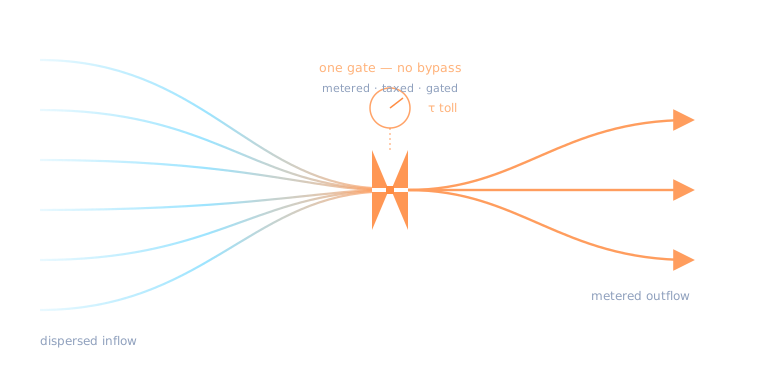
v is a valve if and only if the bypass fraction beta of v is zero, and concentration C of v tends to one, and the switching cost sigma of v is much greater than zero
the three-property test as a gate: fail any one clause and it is influence, not control
Many dispersed inflows converge through one narrow gate with a meter, then continue as metered outflows.
A chokepoint is a valve on a flow: everything routes through the neck, and whoever holds the neck sets the toll.

In the FIC: dollar-clearing, messaging (SWIFT), the Basel reserve standard, US Treasuries as collateral. In the MIC: jet-engine hot sections, guidance-grade chips, specialty materials, and state procurement monopsony. In the TIC: ASML lithography, TSMC fabrication, Nvidia/CUDA lock-in, cloud, and export control as a meta-valve.

05The valves are not where the myth says

The tightest real valves are physical and technological, not financial-dynastic — lithography, fabrication, engine hot sections, dollar clearing. And the second layer of control over those valves is increasingly the state, not private families. The twentieth-century story of banking dynasties at the monetary valve has partly inverted.
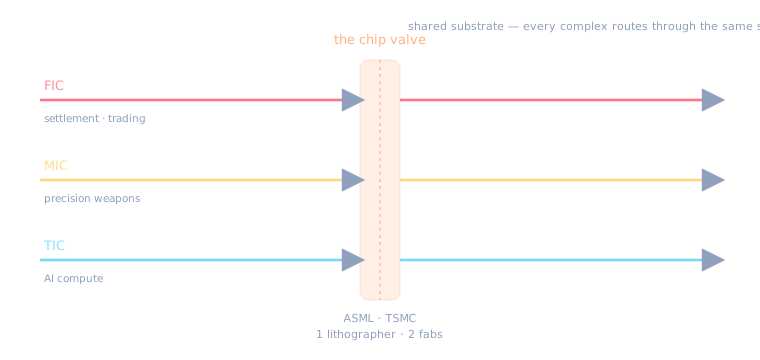
The single sharpest edge: the semiconductor valve is now shared across all three complexes at once. The FIC's settlement systems, the MIC's precision weapons, and the TIC's AI all bottleneck through the same two fabs and one lithography company. That is a concentration of civilizational dependency with no historical precedent.
Three horizontal flows labelled FIC, MIC, and TIC each pass through a single shared vertical chip valve held by ASML and TSMC.
The three complexes are not parallel — they share a substrate. All three route through the same silicon.

06Is the flow being focused?

A static map of valves is not the point. There is constant redistribution of almost everything. The dynamical question: are the chokepoints being used to focus that redistribution — value, capability, and control — toward the few who hold the valves?

phi equals the sum of flow F over gating nodes divided by the sum of flow F over all nodes, bounded between zero and one
the focusing ratio — the fraction of the flow that the valve-holders sit astride

And concentration is arithmetic. Collapse holders that are not independent into blocs; sum squared shares for a Herfindahl index; invert for the effective number of independent holders:

s-i-star is the summed share of a bloc; H-star is the sum over holders of s-i-star squared; N-effective equals one over H-star
after the independence collapse, the apparent crowd resolves into a small effective set

07Demonstrated, not alleged

You cannot subpoena the world. You can read the public record — SEC filings, monetary and fiscal series, contract disbursements, proxy statements, fund vote disclosures — and assert a feature only when multiple independent record-streams co-locate on the same transfer. That is concordance across bearings. Nothing is a photograph; everything is a reconstruction with stated uncertainty.

Ownership at this concentration is not coordination, it is determination — readable from filings, votes, and disbursements. The claim is ungoverned, determinative concentration: a small set of actors holds gating leverage over the conditions of nearly every life. It is provable because it is shown, node by node. Where a deliberation is kept off the record, the method quantifies its effect — not a transcript of what was said.

08The hidden lever

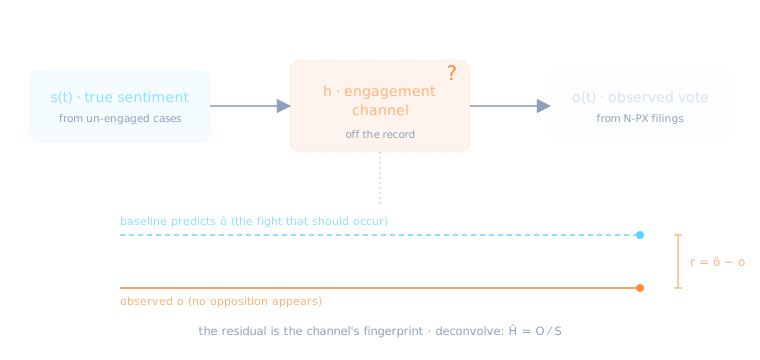
The decisive mechanism is unrecorded: private engagement between asset managers and boards that resolves governance issues before a recorded vote. You cannot see inside it. You can characterize it by its distortion of the signals you can measure.

o of t equals the convolution of s and h evaluated at t, plus n of t
observed outcome = true sentiment convolved with the engagement channel, plus noise
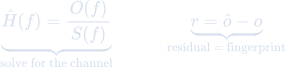
H-hat of f equals O of f over S of f; r equals o-hat minus o
deconvolution recovers the channel; the predicted-minus-observed residual is its fingerprint
Block diagram of true sentiment into a dashed engagement channel box, producing observed vote, with residual between predicted and observed.
You cannot open the box — but the residual between predicted fight and observed calm is the fingerprint.

Four fingerprints, queryable over public timing data: pre-emptive non-conflict; window-clustered concessions; withdrawn proposals; engaged-vs-unengaged divergence. Two hard limits: the channel is adaptive (estimates decay), and it yields magnitude, not content.

09What is being built

Global Control Structures is a money-flow and deal system across FIC/MIC/TIC with three proof surfaces — intent, actions, future — and an immersive instrument that makes those proofs legible. Product first: deal ledger, lineage, technique signatures, math, perishable forecasts. Backend later: point-in-time storage and live multi-clock sources when fixtures are no longer enough. Engineering contracts stay as rails — they are not the product.

Method & evidence

MISSION
Money flow & three proofs
Deals, redistribution, pump–dump signatures; intent · actions · future.
GCS-SYS-001
System Contract
What GCS claims, the demonstration standard, and hard limits on prediction.
GCS-SIG-003
Signal & Inference
Concentration, causality, engagement-channel deconvolution, decay.
GCS-SEC-001
Evidence integrity
Lawful public data only; source authority; no manufactured transcripts.
CHARTER
Product charter
Product surfaces map to the three proofs; contracts as rails.
Engineering contracts (implementation rails — not the public product)

Progress log

2026·07·05 — project opened
Thesis fixed: chokepoints, not dynasties; ownership is determination; claim is ungoverned, determinative concentration, demonstrated from the record. Origin archived in conversations/.
2026·07·05 — mathematics & figures
Valve predicate, chokepoint flow, shared-substrate valve, independence-adjusted concentration, focusing ratio φ, engagement-channel deconvolution and residual fingerprint.
2026·07·08 — scale in motion
Watch the scale move four synced panels 1990→2025, plus One dollar, three ledgers circulation figure. Honesty rules: no shared y-axis; no summing stacked tiers.
2026·07·11 — product reclaim
Immersive redesign: product charter, flagship control topology instrument, study rewritten product-first, engineering contracts demoted to rails. Phase 0D persistence deferred behind the instrument.
2026·07·11 — mission locked
System mission fixed: money flow through FIC/MIC/TIC; political/military/financial/technical deals; redistribution and pump–dump technique signatures; three proofs — intent · actions · future. See mission note.
2026·07·11 — debt-rooted deal pack
Sixteen highest-value fixtures in assets/deal_fixtures.js: Treasury debt root, Fed QE, ON RRP, primary dealers, foreign official holdings, foundations/endowments, BlackRock SMCCF, F-35, Columbia SSBN, Ukraine supplementals, CHIPS Act, export controls, Nvidia/AI, common ownership, interest expense, pensions. Instrument path: print → banks → foundations → complexes → contracts.
2026·07·11 — first live public binds
assets/live_public_sources.js browser-fetches (with stamped fallbacks): FiscalData Debt to the Penny, FRED WALCL (Fed total assets / H.4.1 proxy), USASpending F-35 keyword obligations. Instrument patches deals #1, #2, #8 and shows LIVE pills. Not Phase-1 app ingestion; not concordance by itself.
2026·07·11 — plumbing + hero vertical
Added live ON RRP (FRED RRPONTSYD) and net interest (FiscalData MTS Table 9 line 320). Hardened F-35 hero vertical: debt → Fed assets → RRP → interest service → F-35 obligations → fixture ownership note, with three proofs and decay.
2026·07·11 — GAO lifecycle · 13F · CHIPS · auctions
GAO-24-106703 F-35 lifecycle stamped: sustainment $1.58T, acquisition ~$442B, total >$2T through 2088 (plus USASpending obligation tempo). EDGAR 13F LMT sleeves for Vanguard, BlackRock Inc, State Street (stamped extracts; browser re-fetch when CORS allows). CHIPS hero vertical with authorized package + Commerce mega-awards + keyword tempo. Primary-dealer auction share live from FiscalData.
2026·07·11 — flow regime Markov (7–14d)
assets/flow_regime.js: five plumbing states (PARK · ISSUE · PULSE · SERVICE · TIGHT); transition matrix from FRED RRP history 2021→; live classify from RRP + auction/interest hints; 7d/14d occupancy, entropy, half-life ~10d, favored deals. Instrument mode Regime. HMM-ready emissions reserved (GCS-SIG-003).
next — HMM emissions + OOS skill
Upgrade Markov→HMM with multi-series emissions; auction-day clock; hold-out skill score on point-in-time state paths; independence-audit 13F; promote only with ≥2 bearings + regime tag.

Primary source classes